
TRIDENT: A Shared Foundation for Government Digital Transformation
Ministries, departments and agencies will be able to build on shared identity capabilities instead of creating their own, keeping full control of their services, decisions and data.
Think about a service that still runs mostly on paper. Someone comes to a counter, shows a card, fills in a form with details the Government already holds, signs it by hand, and waits.
Moving that online has always meant solving the same problems first. How do we know it's really them? How do they sign? How do we check the details are correct? Each ministry has had to answer those questions on its own, service by service.
TRIDENT is being built so they only have to be answered once.
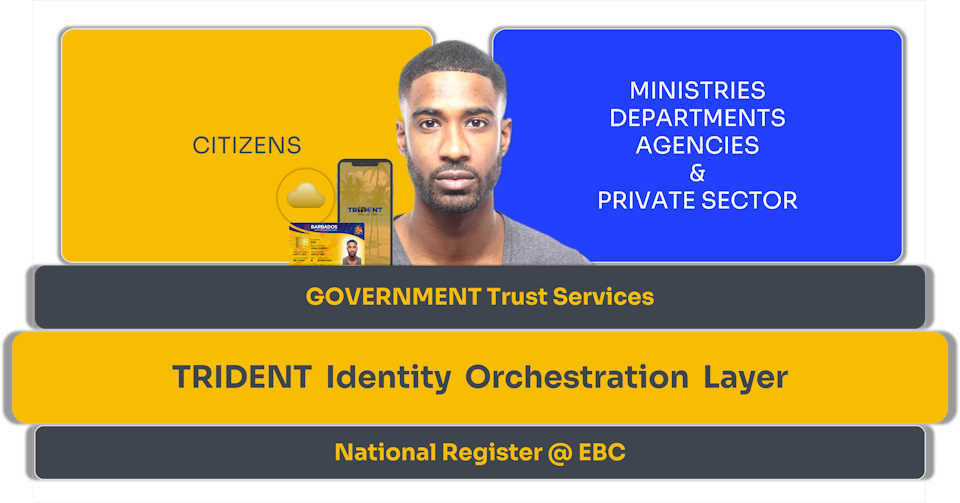
What a service can rely on TRIDENT for
A participating service will be able to confirm a citizen's identity, let them sign in securely, ask for their consent before identity details are shared, capture an electronic signature, or check a credential the citizen holds.
Applied to that same paper process: the applicant signs in with their national identity, their identity details are confirmed without asking for documents again, and they approve the signature from their phone. The ministry receives a complete, verified application.
What stays with the ministry
TRIDENT handles identity. It doesn't take over anything else.
Each ministry, department and agency keeps its own systems, its own records and its own decisions. Eligibility rules, processing, policy and the final determination all remain exactly where they are. What changes is that identity is no longer something each service has to build, secure and maintain by itself.
The Electoral and Boundaries Commission remains the authority for national identity information. Every other institution remains the authority for the records under its own mandate.
Issuing credentials from the records you already hold
Identity comes from the Electoral and Boundaries Commission. But each institution is the authority for its own records, and those records can become credentials.
An agency responsible for driving licences is the authority on who holds one. The registry that records births is the authority on that information. Using TRIDENT's credential services, an institution will be able to issue what it already knows as a digital credential the citizen holds and presents when needed, whether that's a driving licence, a birth certificate or any other attested record.
The institution stays the source. TRIDENT provides the mechanism to issue the credential and the means for a verifier to confirm it's genuine, without every institution having to build its own scheme.
Start with one service, not with everything
Adoption is designed to be progressive. A ministry can begin with a single process, prove it works, and extend from there. The Integration Portal provides protected APIs, technical documentation and controlled test environments so teams can prepare and validate before anything goes live.
This complements the platforms Government already runs. It doesn't require them to be replaced.
Evaluating integration for your ministry or agency?
The article Trust You Can Build On: The Assurance Behind TRIDENT sets out the independent certifications, standards and governance behind the foundation.